I purchased a Concept2 RowERG around about 2020, and it had small amounts of use here and there, before being packed away in late 2023 to clear off our patio. And it stayed in the garage for the best part of the next 2 and a half years.
Cue 2026. After 3 years of personal training with the amazing Tamelah Davis (Too Deadly Workouts), I had gone through several rounds of general strength, power lifting, body building and cut phases, winning a few awards with 8 week challenges here and there for stacking on muscle etc also. Consistency pays off.
But over this time, I consistently neglected cardio. I could back squat near 150kg for 1RM, but sustained exercise was killing me. I would need to regularly tap out of supersets, feeling dizzy and light headed. Sometimes this was dehydration or lack of adequate nutritious fuel, but I have become acutely aware of my raising resting heart rate, and poor heart rate variability (as ‘accurately’ measured by my Fitbit).
After recently moving house, we decided to pull the RowERG out and it’s now in the air-conditioned comfort of our living room. Step 1, tick.
I jumped on and did 10 minutes of this and that, no real goals. I just knew I need to get back into this consistently. I needed a plan.
Setting a Goal
From my past RowERG data, I know I can do an easy 2:30 pace for 500m. Sustaining this for 2,000m (2km) however, is a different question. I pondered what 2km looks like for elite rowers, and where I sit, and was not surprised at being a lowly beginner.
| Rank | Time (Pace mm:ss/500m) |
|---|---|
| Beginner | 9-12 minutes (2:15-3:00/500m) |
| Intermediate | 7-8 minutes (1:45-2:06/500m) |
| Elite | < 6 minutes (1:30/500m) |
At roughly 10:00 per 2km, I’m dead center beginner.
As part of my gym work, I regularly do seated rows, so the rowing movement is not new to me. I set about transforming this into a high performance rowing time – so I figure let’s just stick to intermediate for now, around 7:30.
The Plan
Consistency. Not only that, but fixing some issues I’ve had with rowing in the past; comfort and mastering the technique will make sitting on the RowERG longer than 10-20 minutes more bearable – something I’ve struggled with in the past. Discomfort in the groin area and a bit of extra tummy fat doesn’t help, so a bit of research here helped. Pushing my knees outwards at the catch helped.
This is where some fantastic analytical tooling comes in to play. Combined with the data from my ErgData account and ChatGPT, I was able to get feedback on my initial comeback. I completed 2 rows with different rhythms and techniques, and ChatGPT provided some fantastic feedback; I need to control my pace. For the most part, my hard rowing was closer to 28spm, but with proper technique I should be able to maintain efficient power at about 20-24spm. Elite pacing for a 2k might be closer to 36spm, but I’m not there yet – we’re building up to it! ChatGPT confirmed I should be aiming to get my technique correct at around 18-24spm, so I worked through planning a 3 or 4 day per week plan incorporating a mix of VO2 building intervals, threshold intervals, and steady, longer sessions (around 20-30minutes).
| Workout | Why | Breakdown | Effort |
|---|---|---|---|
| Steady 20-30mins | Aerobic base, fat loss, build the endurance ‘engine’ | 20:00 to 30:00 of consistent pace | RPE 4-6 |
| VO2 Building | Improve VO2 max (top end) | Time Intervals – 8 x 1 minute with 1 minute rest | RPE 8-9, rest easy |
| Threshold | Raise the ‘hard’ pace | Time intervals – 4 x 4 minute with 2 minute rest | RPE 7-8 |
| 2K rehearsal | Practice the 2k rhythm and learn what 2k feels like | Distance intervals – 4 x 500m with 2 minute rest | 500m controlled, 1000m rhythm, 500m squeeze, empty the tank for last 250m |
For each session, I created some ‘success’ rules:
- Steady – feel like I could do 5-10 minutes more
- Vo2 build – all reps within +/- 3 seconds
- Threshold – final interval should be same or slightly faster than first
- 2k rehearsal – Rep 4 best interval
First Session
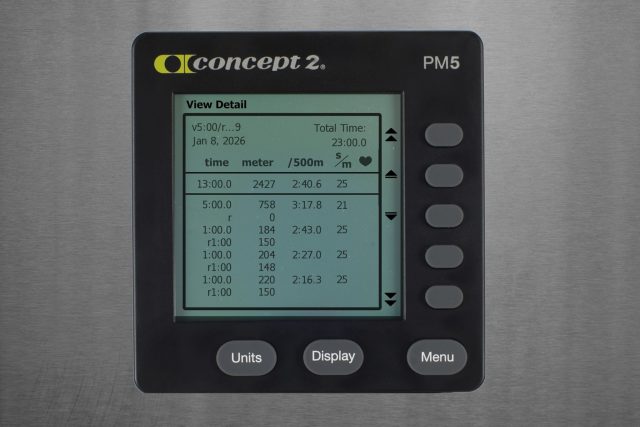
The first session started with a 5 minute warm up, then straight into the VO2 building workout. By the end of the first 5 minutes, I was comfortable and ready to go. I found that programming the PM5 was best done via the ErgData app, as the PM5 itself is a bit slow and clunky for programming intervals. I programmed this session as 8×1 minute intervals (time based), with a 1 minute rest, and during the row, it would count down to the end of each interval before going into a rest period. I noticed that during the rest period, no stats were shown around current effort, so your spm rate is not shown, and you can’t guage your effort. One thing I did to overcome this was use the ‘force’ display, which shows a curve of your stroke force.
Checking In
All of my row efforts from here on in will be on ErgData, synced to Strava. Data is easily exported from ErgData to CSV, which my ChatGPT session can analyse and provide tips on.
Over the next 12 weeks, I expect gradual improvement on each of the workouts and will aim to do a 2K test every 4 weeks.